Martha Rose Shulman’s Mediterranean Vegetable Pies

veggiepie01

I’m starting to think of Martha Rose Shulman as my personal hero. Those may be strong words to describe the author of the Recipes for Health section of the New York Times, but Shulman’s seasonal and healthy recipes—which often focus on one ingredient per week, prepared in myriad ways—never fail to inspire me. I’ve been hooked ever since I tried her sweet potato and butternut squash soup over the winter, and then her light and healthy Swiss chard lasagna a month later. Now I check out her column eagerly, every week, just to see what she’s up to.

A few weeks ago, Shulman published an article about Mediterranean vegetable pies. She describes these pies, which stuff seasonal produce, eggs, and cheese into pastry shells or phyllo dough, as wonderful ways to utilize seasonal produce in vegetarian main dishes. In addition to providing a recipe for an intriguing whole wheat pastry dough, she lists four different pie variations. I printed out every recipe, and couldn’t wait for an opportunity to try them. Luckily, I didn’t have to wait very long.

Last weekend I came home from my CSA pick-up overloaded with greens. I had piles of spinach, kale, and bok choy, as well as two small zucchini, snow peas, and garlic scapes. I always fear that the vegetables I receive from my CSA will wilt before I have a chance to use them, so I decided to cook as many as possible into one of Shulman’s vegetable pies. And although the recipes didn’t address all my ingredients specifically, I hoped that they were flexible enough to accommodate some variations. Using Shulman’s recipe for a Provençal zucchini and Swiss chard tart as my guide, I combined the spinach, kale, and zucchini with Gruyère cheese and fresh eggs that I had picked up at the farmers’ market.

veggiepie02

As Shulman had claimed, the pie was indeed a bit time-consuming to make, but it was totally worth the effort. I rolled out the pliable whole wheat dough easily, which created a light and crumbly base for my egg and vegetable mixture. When I pulled the tart from the oven an hour later, flecks of rustic greens were supported by a sea of brilliant yellow eggs, presenting a farm-fresh meal that I couldn’t get enough of. Hot from the oven, the pie was an airy and gently tasty main dish. I brought slices of it to work for lunch all week, eating it at room temperature and almost enjoying it more that way.

So do you see why Martha Rose Shulman is my hero? I don’t need her to leap tall buildings in a single bound, but now I rely on her for delicious recipes that also happen to be healthy. It’s a lot of pressure for one person, but I am sure she can handle it.

Recipe for Spinach, Kale, and Zucchini Tart (adapted from Martha Rose Shulman’s recipe for a Provençal Zucchini and Swiss Chard Tart in the New York Times Recipes for Health section)

  • 1 lb of spinach, washed
  • 1/2 lb kale, washed, leaves picked off from the stems and thick ribs cut out
  • salt
  • 2 tablespoons extra-virgin olive oil
  • 1 medium onion, chopped
  • 2 small zucchini, cut into a small dice
  • 3 large garlic cloves, minced
  • 1 teaspoon fresh thyme leaves, chopped
  • 1/2 cup Gruyère cheese, grated
  • 3 large eggs
  • freshly ground pepper

While the dough is rising, prepare the vegetables. Bring a large pot of water to a boil. Fill a separate bowl full of ice water. When the water in the pot reaches a rolling boil, add salt and the kale leaves. After 30 seconds or so, add the spinach leaves. Blanch for 1 minute. Using a slotted spoon, transfer the greens to the ice water, then drain. Squeeze out excess water from the greens and chop them. Set aside.

Heat olive oil in a large non-stick skillet over medium heat. Add the onion and cook until tender, stirring, for about five minutes. Stir in the zucchini and season to taste with salt. Cook until just tender, about 10 minutes. Stir in the garlic and thyme. Cook everything together until the garlic is fragrant, about one or two minutes. Stir in the greens, toss everything together, and remove the pan from the heat. Season with salt and pepper.

Beat the eggs in a large bowl. Stir in 1/4 teaspoon salt (to taste), the greens and zucchini mixture, and the cheese. Mix together and add a bit of pepper for seasoning.

Preheat the oven to 375 degrees. Oil a 10-inch tart pan with a removable bottom. Roll out two-thirds of the dough very thin, and line the pan, with the edges of the dough overhanging. Freeze the leftover dough. Fill the dough shell with the greens and zucchini mixture. Pinch the edges of the dough along the rim of the pan. Place in the oven and bake for 50 minutes, until the mixture is set and beginning to color. Allow to rest for at least 15 minutes before serving. This tart can also be served at room temperature. Serves 8 to 10 people. Enjoy!

Comments (2) »

Nunu Chocolates and a Bridal Shower

chocolatebox

A maid of honor has numerous responsibilities. Some are emotional, such as keeping the bride calm and radiant on one of the most special days of her life. Others are more practical, like making sure all of the other bridesmaids are wearing the same color shoes. (Yes, it really does matter.) But perhaps the most crucial maid of honor responsibility is hosting a kick-ass bridal shower. A few weeks ago, I threw one for my younger sister Melissa, who is getting married in August.

For the favors, I turned to Justine Pringle of Nunu Chocolates in Brooklyn. I knew these handmade chocolates, with their creative fillings and shapes, from tasting them at the Brooklyn Flea last year. Pringle opened her own shop on Atlantic Avenue a few months ago, and that’s where I met her to discuss the favors. Tall, blonde, and extremely friendly, she asked me several questions about the upcoming wedding, my sister’s sense of style, and her wedding colors. We looked at different colored gift boxes and quickly came up with a plan for the package design. I knew within minutes that I had chosen the right person to create something special for my sister.

While I was originally interested in using Nunu’s chocolates because they tasted so delicious, I was also attracted to the story behind them. The chocolate ganaches, caramels, and other chocolate products at Nunu are totally natural, made from cocoa beans procured directly from a sustainable farm in Eastern Colombia. Being environmentally conscious has always been a strong theme in Pringle’s life, as she has a degree in Environmental Management and Technology, and worked in environmental waste management before turning to chocolate. Looking for unique merchandise to sell at husband Andy Laird’s music concerts, she studied at the Ecole Chocolat and started making chocolates. They soon became popular in their own right, and Nunu Chocolates was born.

chocolates

For my sister’s favors, Pringle and I selected four different chocolates that demonstrated a wide range of Nunu’s flavors. I was immediately attracted to the salt caramels, whose gooey caramel center combined perfectly with the rich chocolate and crunchy salt on the exterior. The festive prosecco ganache was entirely appropriate for an Italian-American themed shower, while the floral earl grey and sweet organic raspberry ganaches calmly closed the day’s festivities. Unique and tasty, they were coveted by everyone who came to the shower.

Pringle will soon build a beer and wine bar, as well as a production kitchen, at her Atlantic Avenue shop. I can’t wait to stop by and relax with a selection of chocolates and a nice glass of wine, perhaps after Melissa’s wedding later this summer. Until then, a maid of honor’s work is never done.

Nunu Chocolates, 529 Atlantic Avenue, between 3rd and 4th Avenues, in Brooklyn. T: 917-776-7102. Check the website for ordering information and other locations that sell Nunu Chocolates.

Leave a comment »

Conundrum

chokes

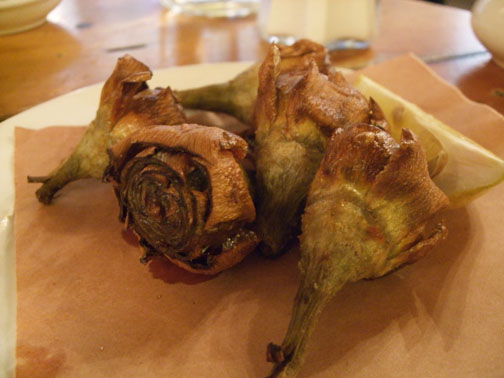
OK, readers, I need some help. What am I supposed to do with this massive can of artichokes that Jim brought home for me as a surprise? I don’t know if you can get a sense of its size from the photo, but there are at least 4 cans worth of artichokes and their stems in there.

What do you think? Risotto? Pasta? Can I freeze any leftovers once they are taken out of the can? How long do canned goods last? (I know this can has been around for a while, but there isn’t an expiration date on it, and I am a little nervous about it.) Normally I’d rather cook with fresh produce, but come on, people, we can’t let all these artichokes go to waste!

Also, I need to get this can off my kitchen counter. It is taking up way too much space. Help me, please.

Comments (4) »

Lobsters from the Red Hook Lobster Pound

pound

Red Hook, Brooklyn, is known for its shipyards, rickety docks, and longshoremen. But lobster? I’ve heard good things about the lobster rolls at Fairway, but local residents Ralph Gorham and his wife Susan Povich are taking these coveted crustaceans to another level, with their newly-opened Red Hook Lobster Pound on Van Brunt Street. 

The concept behind the Lobster Pound is a bit unusual, even for the most rabid food enthusiast: Gorham drives up to southern Maine (to towns such as Kittery and Wells) on Thursdays, and trucks back iced cratefuls of live lobsters for the weekend. He purchases them directly from local fishermen, right out of the Maine seawater. By the time Gorham returns to Red Hook, the lobsters have only been out of the water for 5 to 6 hours. Upon arrival at the shop, they are immediately transferred to Gorham’s personally-crafted lobster tanks. He worked with a biologist to mimic Maine seawater through the addition of elements like salt and crushed coral, and maintains a water temperature of 38 degrees. 

tanks2

It’s obvious within minutes of meeting Gorham that the Lobster Pound is a labor of love. He describes the long drive to Maine as relaxing, and recounts how he used to go lobstering for fun while spending time at his wife’s home there. While he recently realized he could turn his hobby into a money-making endeavor, Gorham stresses that he does his best to bring down just enough lobsters to fill the weekly orders, so that waste of extra lobsters is prevented. This is why it’s best to place orders by Thursday for the upcoming weekend, before Gorham makes the trip to Maine and starts purchasing them. The shop opens for pick-ups on Friday, and closes when the lobsters are sold out.

gorham

When Jim and I asked for advice on how we should cook the two 1-1/2 pound lobsters we had ordered, Gorham told us just to steam them in 4 inches of salted water for 6 to 8 minutes. Before we left, he packed up some Maine seaweed for us, and told us to use just a bit of it in place of sea salt.

home

I won’t bore you with the details of our lobster cooking escapade on Saturday night; let’s just say it involved a lot of fearful cringing, a pair of tongs, and a few minutes of remorse while the lobsters quickly steamed in a big white pot on our stovetop. But once we sat down to eat them with just a bit of melted butter on the side, it was a different story. Sadness turned to joy as we ate bite after bite of the freshest lobster I’ve ever had in New York. And that seaweed made all the difference, imparting just the right amount of sea-salt flavor to the clean, savory meat. I’m not sure I can make a habit of this—lobsters are always a bit of a splurge, and our two guys cost $30 all together (about $9.50 a pound)—but Gorham recently received permits to sell lobster rolls straight out of the shop, as well as at the Brooklyn Bridge Flea. Sorry Fairway, but I’m getting my lobster at the Pound.

lobster

The Red Hook Lobster Pound, 284 Van Brunt Street between Visitation Place and Verona Street. T: 646-326-7650. It’s best to place your orders by phone or email (redhooklobster[at]gmail.com) by Thursday. Prices change weekly. Check the website for updates.

Comments (4) »

Farmers’ Market Find: Mushrooms from Madura Farms

A few weeks ago I sent Jim to the Carroll Gardens farmers’ market by himself. I don’t remember why I didn’t go with him; I was probably busy cleaning the apartment or getting ready to run somewhere else that Sunday morning. In any case, when Jim returned to the apartment, laden down with various bags and packages, he had quite a surprise for me. Take a look:

mushrooms

He had picked up two gorgeous and ruffled mushroom pom-poms—oyster at the left side of the photo and maitake at the right, to be exact—from the new Madura Farms mushroom stand at the market. Together they cost about $13. I had wanted to write about them earlier this month, but it took me until this past weekend to stroll by the market and chat with the vendors myself. Within a few minutes, I learned that Madura Farms cultivates these mushrooms on their farm in Goshen, New York, and sells many other varieties such as button, shiitake, and portobello. Afterwards I wanted to kick myself for not specifically asking how Madura’s mushrooms are grown, but Under the BQE describes how the farm raises its various fungi in mushroom “houses,” and that they are farmed in tune with organic practices. At least someone around here is doing their research!

I found these mushrooms almost too beautiful to cook; I wanted to admire them for every angle, indefinitely. But we finally decided to break them apart, piece by piece. We sautéed them in olive oil with just a bit of salt and pepper, and added them to one of our famous homemade pizzas with some spicy sausage from Esposito’s. As predicted by the folks at the Madura farm stand, these massive mushrooms cooked down significantly, and we were left with just the right amount for our pie. 

pizza

The meaty texture and smoky flavors of the two mammoth shrooms paired well with the pie’s fiery sausage, creamy mozzarella, and slightly sweet, whole-wheat crust. With every bite, Jim and I tried to ferret out the mushrooms from the meat, enjoying each element on its own and then together. Jim determined that the maitake was his favorite of the two, as he enjoyed its nutty, full flavors more than the milder oyster mushroom.

In retrospect, I doubt I would have picked up those imposing mushrooms if I went to the market on my own; in many ways I am not as adventurous as my husband. Perhaps I should send him to the market alone more often. Who knows what he will bring home next?

Comments (2) »